Software products
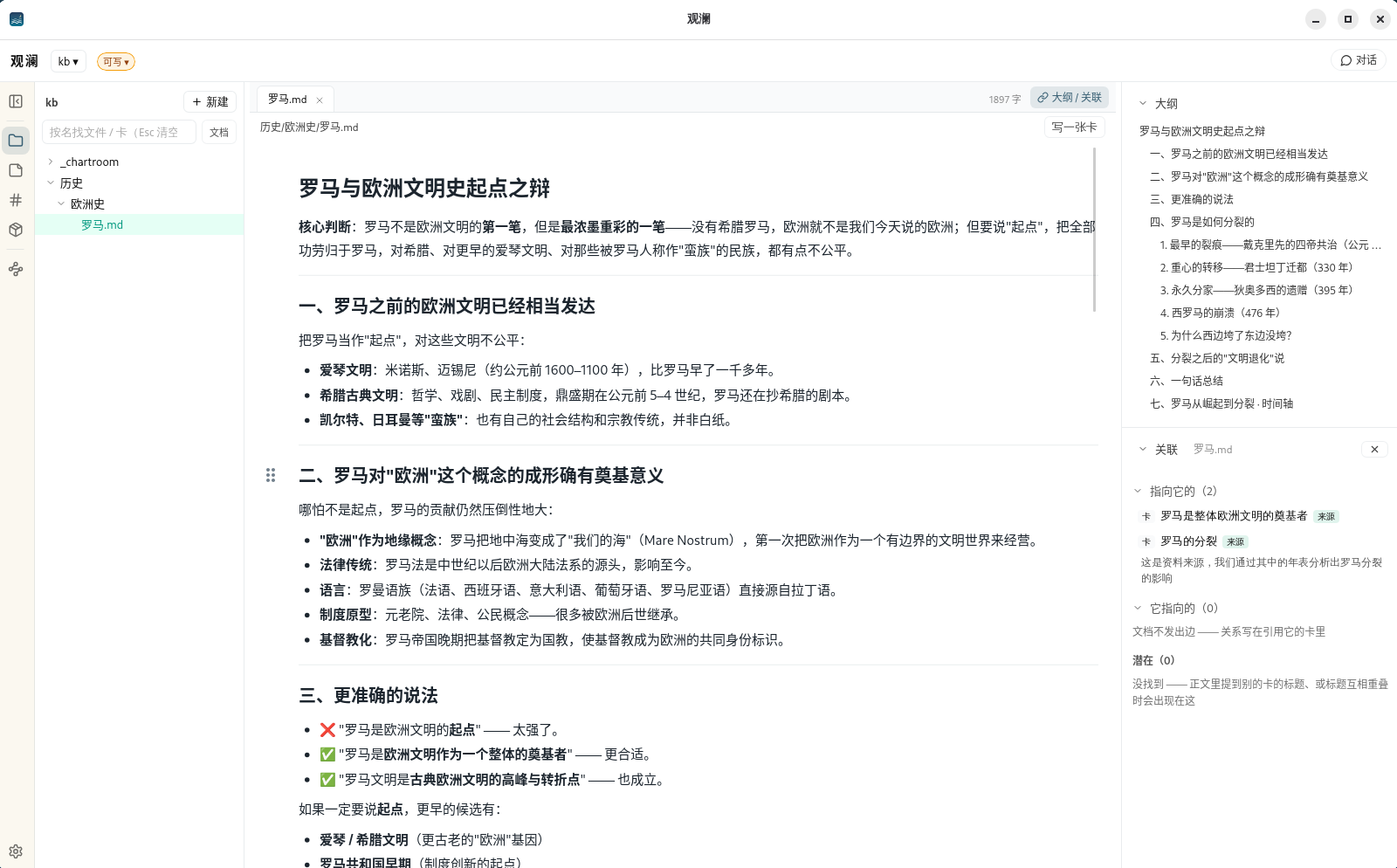
Desktop apps that put large language models in ordinary people's hands: organizing reading material and writing long fiction. Everything lives as ordinary files on your own computer.
- AI research assistant
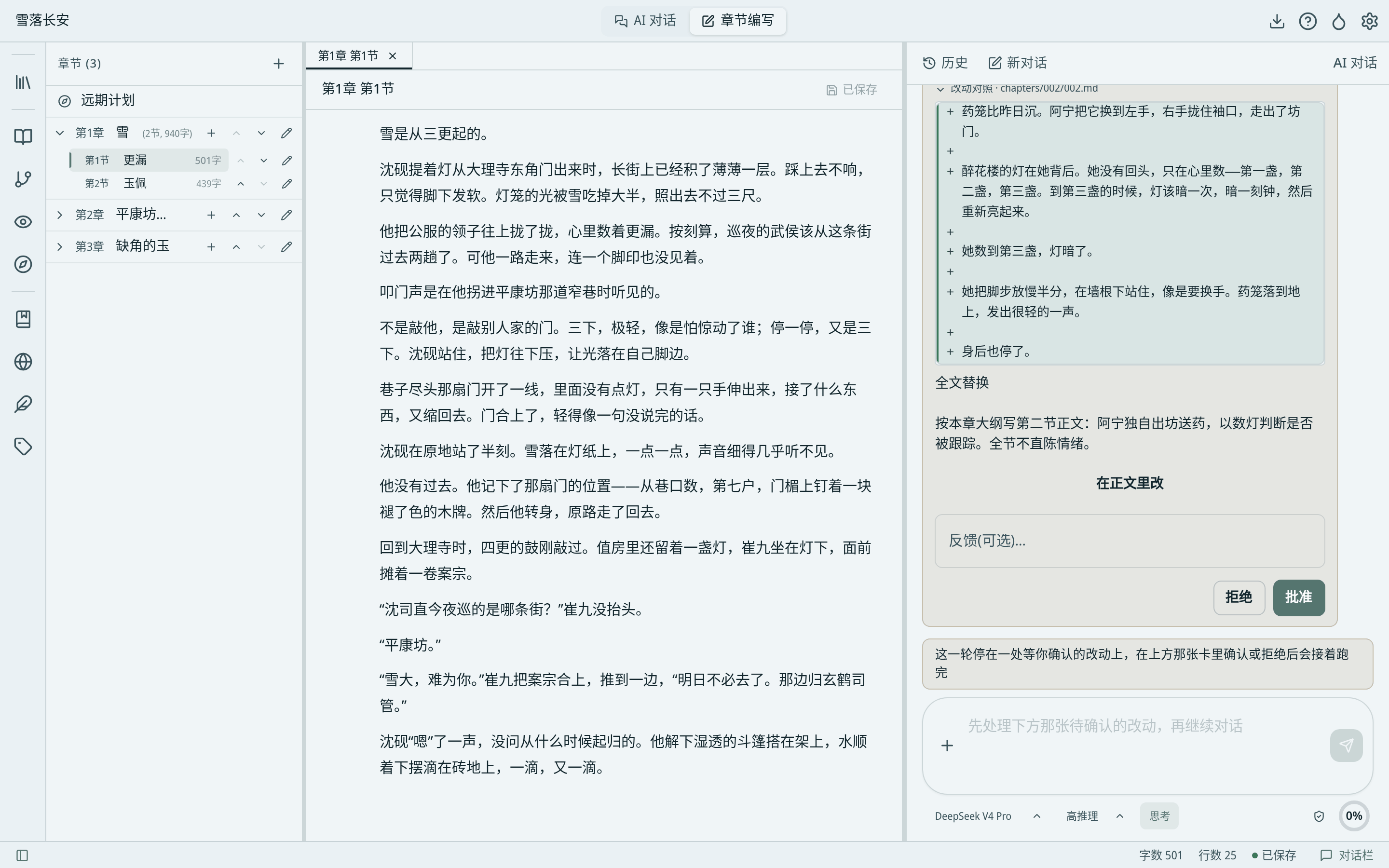
- AI long-form writing
TTalk 言几 · The Talk
We are a software and data company built around large language models. We turn models into handy products — Guanlan reads your material, Jinshu writes long fiction — and build the data layer beneath them: libbitcask packs KV, full-text, and vector search into one embedded engine. The agent and web frameworks we built along the way are open sourced too.
What we do
The large language model is the core. Software puts it in people's hands, data makes it work well, and frameworks let developers build fast.
Desktop apps that put large language models in ordinary people's hands: organizing reading material and writing long fiction. Everything lives as ordinary files on your own computer.
LLM applications live on retrieval: full text, vectors, hybrid fusion, plus transactions and graphs. We write our own storage and retrieval engines and embed them in the app — no extra service to run.
The frameworks we built for our own products, cleaned up and open sourced: AI agent frameworks for Erlang/OTP and Clojure, template and Markdown rendering, and a server-rendered web framework.
Software products
Write code, organize reading, write novels. Installed on your own computer — your files stay yours.
Software product
Watch your knowledge flow
An AI research assistant that lives on your computer. Point it at a folder to ask questions, organize cards, draw link graphs, build slides.
Software product
The AI writing partner that remembers your world-building
An AI partner for long-form fiction. Characters, foreshadowing, plotlines, what the reader already knows — all remembered, with self-checks after every chapter.
Software product
An Emacs-style code editor, rebuilt in Clojure
An Emacs-style editor rebuilt in Clojure: Emacs keybindings, tree-sitter highlighting, LSP, project tree, Git, REPL, and themes. Free download.
Explore Coxswain →Download for Windows · approx. 80 MBDownload Linux DEB · approx. 74 MB
Data products
Search, transactions, and graphs in one embedded engine. Guanlan's search runs on it.
Data product
Embedded KV and search engine
A Bitcask append-only KV store in C++23, layered with BM25 full text, vector nearest-neighbor, and RRF hybrid search. A C++ library to use directly, plus a C ABI for bindings in other languages.
Data product
Search, transactions, and graphs for Erlang/OTP
libbitcask brought into Erlang/OTP via a NIF: KV, full text, vectors, hybrid search, and structured queries — plus transactions, idempotency keys, graph processing, and local embeddings.
Frameworks
AI agent frameworks for Erlang/OTP and Clojure, plus a rendering engine and a web framework — all Apache 2.0 open source.
Framework
The AI agent framework for Erlang/OTP
Build AI agents on Erlang/OTP: a unified LLM client across six vendors, ChatClient and tool calling, onion-style filters, and a ReAct agent with conversation memory.
Framework
Tools, RAG, and protocol extensions for BeamAI
Extensions on the BeamAI core: file / shell / human-interaction tools and middleware, RAG, an MCP client and server, the A2A protocol, and an AG-UI event-stream server.
Framework
Template and Markdown rendering for Erlang
Mustache and Jinja2 templates compile to Erlang modules at build time — rendering is one function call — plus a Markdown engine ported from markdig with 30 extensions. Zero dependencies.
Framework
Web pages written in Erlang functions
Assemble pages from Erlang functions with complete server-side HTML; clicks are answered statelessly by Erlang functions and server pushes ride SSE. 112 components, four theme axes, SEO-friendly.
Framework
The AI agent framework for Clojure
Build AI agents in Clojure: deftool for declaring tools, ChatClient and filter middleware, five hook types, a SimpleAgent that can pause for approval, and adapters for a dozen-plus model vendors.
How we work
Your material and drafts are ordinary files on your computer — open them in any other program, back them up whenever you like. Guanlan never modifies a single original file.
No account required; searching your material happens locally. AI conversations can use DeepSeek, Qwen, Kimi and other online services with your own account.
AI never edits quietly. Jinshu marks every revision word by word and applies it only after you confirm; Guanlan puts its output in a draft folder until you approve it into the library.
Guanlan's search runs on our own data engine, libbitcask. No external database service — install and it just works.
Where the name comes from
夫易,圣人之所以极深而研几也。
Together: seeing the sign in language, seizing the moment in the subtle. Yán is the software that lets models converse; jī is the craft of pulling signal out of data and retrieval.